A buzzword that is being used a lot these days is inclusion. I think it’s important for Christians to remember that who we are and what we are called to do does not change with society. Today we look at how a Christian responds to changes is society.
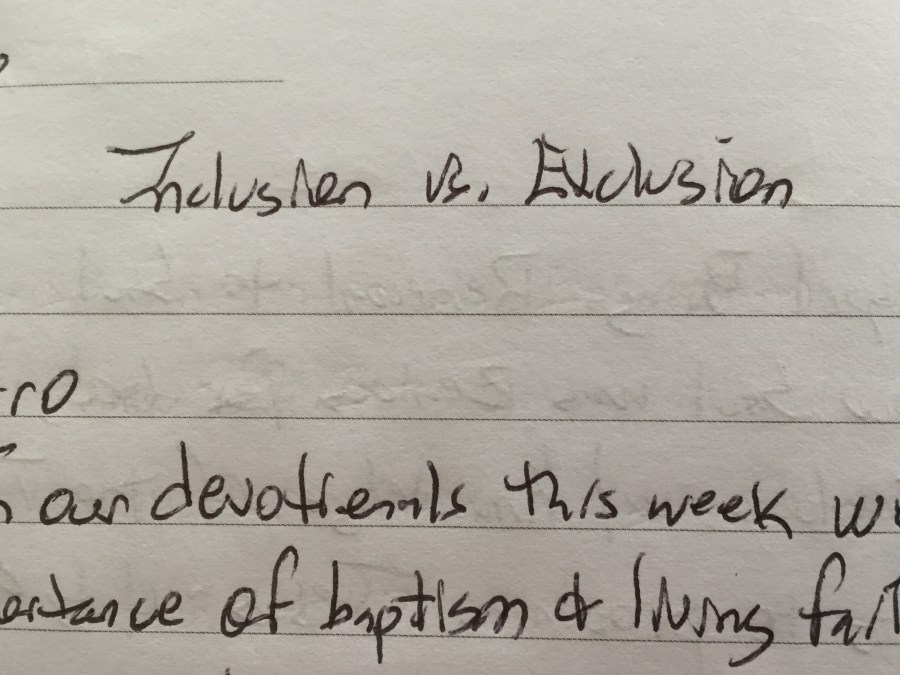
Inclusion vs Exclusion
I. Intro
A. In our devotionals this week we studied the importance of baptism and living faithfully.
B. These are two things many religious people have a problem with.
C. As we see the Biblical importance that’s placed on both it brings up an important question – Why would you not do what scripture says? Why would you argue with scripture?
D. At the heart of the issue we find that it’s simply not what people want to do. If it’s against what I want then I change it to meet what I want. So it goes in our day and time.
II. A Troubling Issue
A. I am not going to be political today. What I say may be something you agree with or it may be something you disagree with.
B. The latest troubling issue is the debate over transgender people and their bathroom choices.
C. Notice I said the “latest” issue. Before that it was homosexual marriage, divorce and remarriage, abortion, etc.
D. This issue is no different for a Christian because what we believe in and what we are to be has not changed. The world changes, the church does not.
III. Inclusion vs. Exclusion
A. The buzzword today is Inclusion.
B. Both sides of this disagreement argue over inclusion & exclusion not realizing that both are choosing exclusion.
C. If you say I am inclusive and then insult, demean or shout down someone that doesn’t agree with you then you are being the opposite of what you claim.
D. As Christians, when we start talking about who we will boycott as a group and lumping people in with others as evil and dangerous are we not doing the same? Have we become the judge?
IV. Jesus and Inclusion & Exclusion
A. Matthew 9:9-13 – Jesus calls Matthew a tax collector and then eats with tax collectors and sinners.
B. We may not understand why people are the way they are. That might cause us to look at them the way the Pharisees did here. We cannot ignore the truth of God’s word but we must treat people with respect.
C. John 4 – Jesus visits with the Samaritan woman at the well. Jesus ignores social norms. Notice what his disciples said in John 4:27. Could we be guilty of falling for societies norms like the disciples were? Who would you exclude from your assembly?
D. Matthew 21:12-13 – Jesus drives out the money changers. Matthew 23:33 – Jesus condemns the Pharisees. Is it not interesting that the people Jesus excludes are supposed to be religious leaders?
V. What does all this mean for us today?
A. We must obey God rather than man. God’s law supersedes man’s law.
B. We can’t ignore what the Bible calls sin. We must teach the truth as it was presented not as we want it to be. We must preach against all sin not just certain sins.
C. At the same time we must remember that the church is not a house for righteous people to meet. It’s not for the perfect, but is made up of the imperfect who want to live for Jesus who can make them perfect.
D. We should be as inclusive as possible. No one should be turned away from worship and the chance to know the gospel. There may be some exceptions such as we find in I Corinthians 5 or for safety concerns.
VI. Conclusion
A. There are some hard issues to deal with in our society.
B. We don’t change who we are or what our purpose is because of these issues.
C. Matthew 25 – Jesus divides the sheep from the goats. Does he say “In as much as you have done it to the ‘righteous’ least of these. No he does include righteous. That means we treat everyone with respect and try to help all we can.
D. As Christians we must be careful what we say and how we respond to changing times. We must always live for Jesus and bring others to Him.
 Bible Lessons and Sermons